 Buketov University
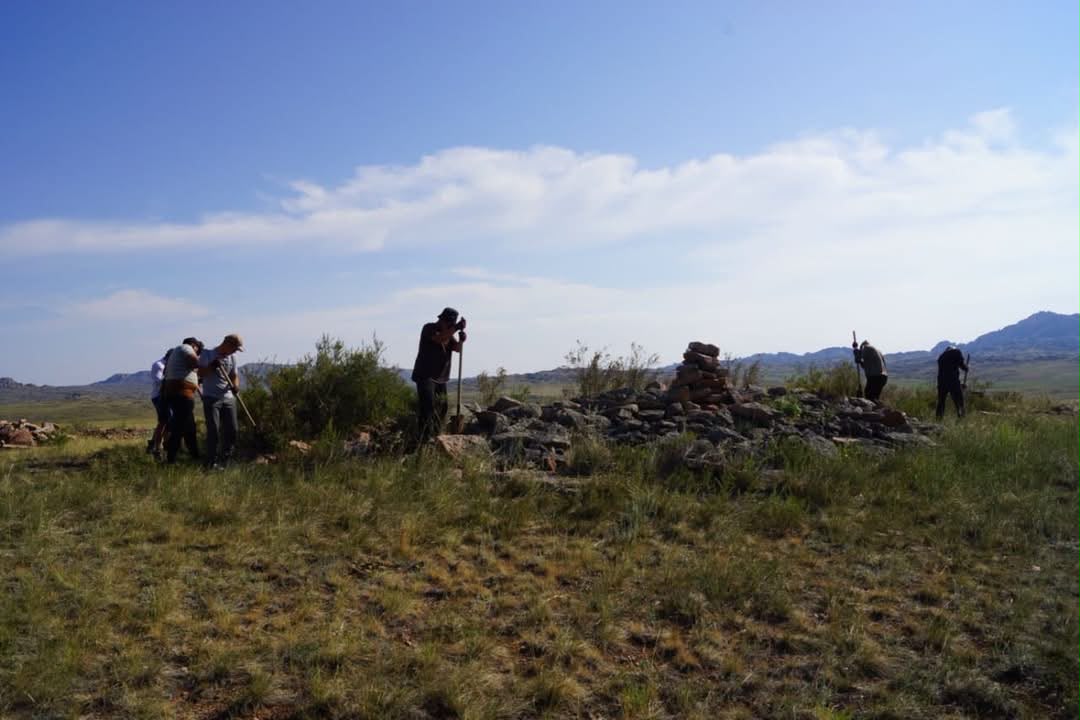
The study of an Early Iron Age burial discovered in Structure No. 2 of the Ketaban burial ground has yielded new insights into the material culture and daily life of the ancient population of Central Kazakhstan.
Despite the fact that the burial had been looted, archaeologists were able to identify a distinctive assemblage of finds, including a bronze dagger, arrowheads of various types, a narrow lanceolate object, a stone whetstone, and a fragment of a horn overlay.
Analysis of the archaeological materials made it possible to attribute the burial to the Tasmola culture and date it to the 7th/6th–4th centuries BC. Similarities between the arrowheads and finds from other sites belonging to the Scythian-Saka cultural circle help expand our understanding of the cultural connections between ancient communities.
The study of the bronze dagger is of particular interest. The results of X-ray fluorescence analysis suggest that certain elements of its hilt, particularly the crossguard and pommel, may have been manufactured separately.
Another important aspect of the research concerns narrow lanceolate objects traditionally interpreted as knives. A comparative analysis of their shape, attachment methods, and archaeological context suggests that some of these objects may have been used as razors. Traceological analysis also confirmed the practical use of the stone whetstone.
The findings contribute to the scholarly understanding of assemblages from Early Iron Age burials, ancient craft technologies, and the everyday life of the population of the region.
Reference:
Kukushkin, A. I., Dmitriev, E. A., & Blinov, I. A. “An Early Iron Age Burial at the Ketaban Burial Ground (Central Kazakhstan).” Archaeology of Kazakhstan, 2026, No. 3 (33), pp. 356–373 (Q2, CiteScore 2025: 1.1).
Full-text publication:
https://www.archeokz.com/index.php/archeokz/article/view/782/563
News
SECRETS OF AN ANCIENT BURIAL: NEW INSIGHTS INTO THE TASMOLA CULTURE